
Patient Safety
“Safety in surgery” Contributions beyond the call of duty
Here are a few examples of Professor Amir Nisar’s contributions at the highest levels in United Kingdom and Europe.
SLIPS
Safety and Leadership
in Interventional Procedures in Surgery
Every surgical procedure, irrespective of its complexity, carries inherent risks and the potential for unforeseen complications. The successful and safe conduct of surgery depends not only on the knowledge, technical competence, and clinical judgement of individual practitioners but also on effective teamwork, leadership, communication, and the consistent application of established safety principles. Team dynamics, procedural variables, and unexpected intraoperative events further influence patient outcomes. Recognising these challenges, SLIPS – Safety and Leadership in Interventional Procedures in Surgery represents a comprehensive approach to promoting patient safety, strengthening surgical leadership, and establishing a culture of excellence within the operating theatre.
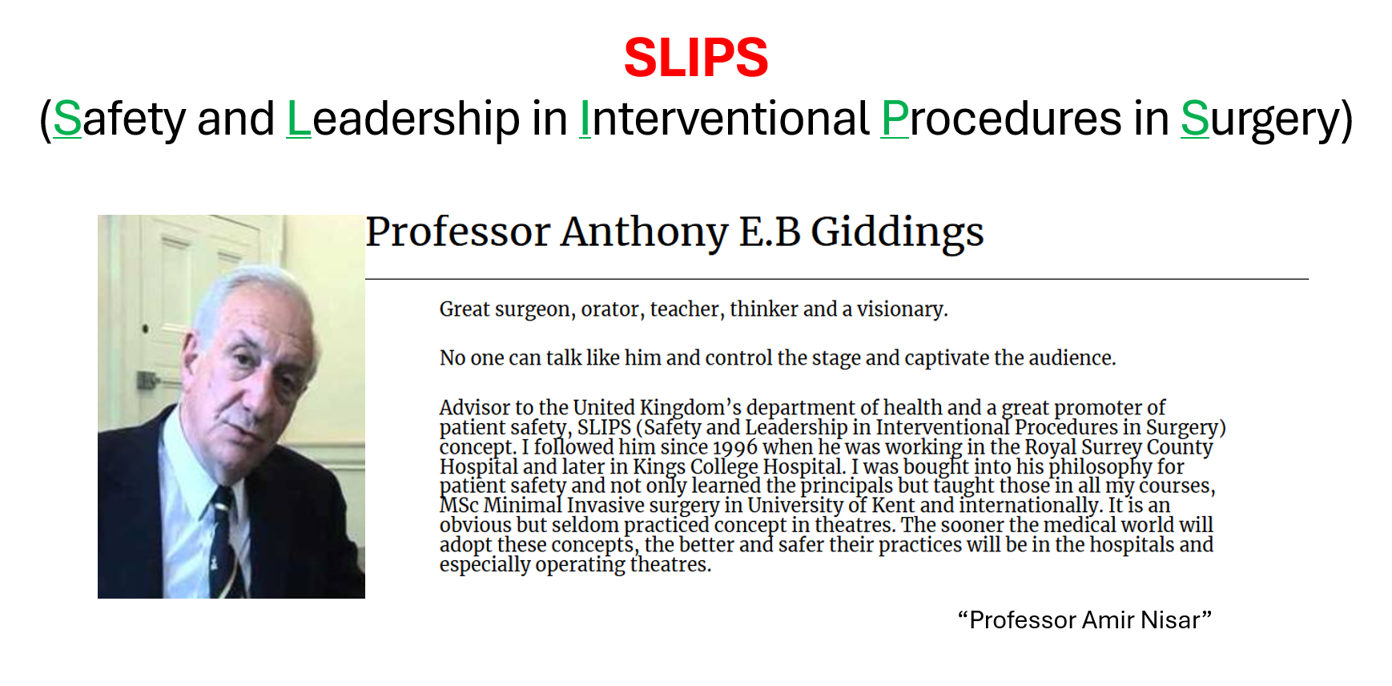
Professor A. E. B. Giddings pioneered the SLIPS concept and its associated educational programme in the United Kingdom in 2004. Since the 1990s, he has made significant contributions to the advancement of patient safety, including his role as an adviser to the United Kingdom’s Department of Health. Through his longstanding professional association with Professor Giddings, Professor Amir Nisar developed a profound understanding of the principles underpinning SLIPS and their practical application in modern surgical practice. These principles have subsequently become integral to his clinical work and his extensive teaching activities, conducted over several decades at the highest professional levels, both within the United Kingdom and internationally.
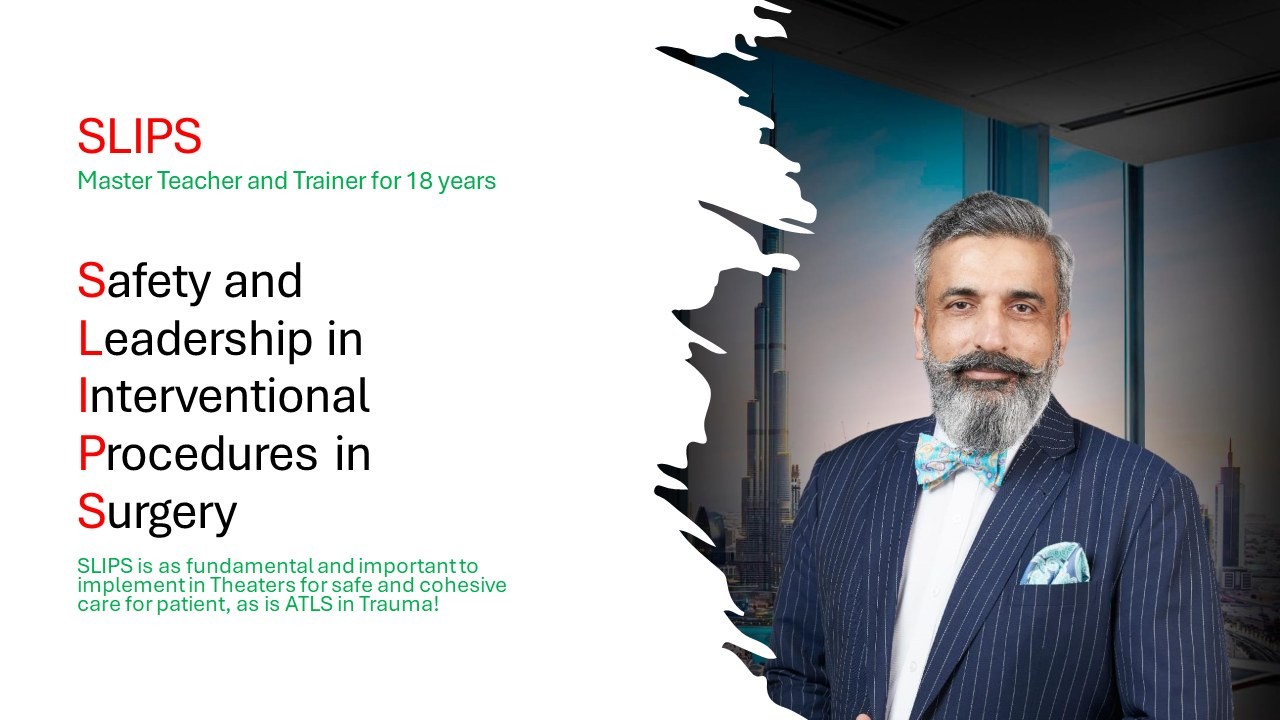
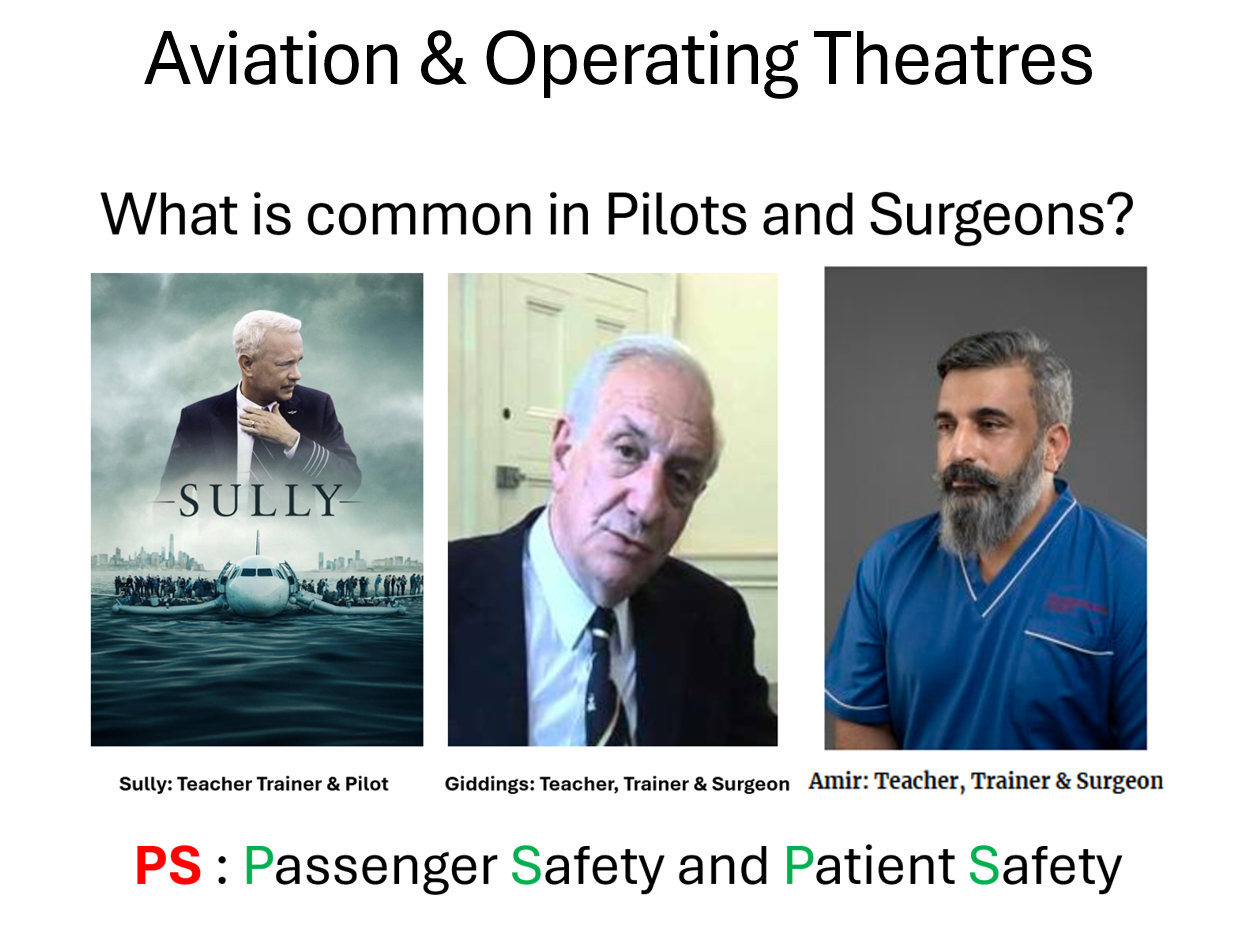
The importance of SLIPS within the operating theatre may be compared with that of Advanced Trauma Life Support (ATLS) in the emergency department. ATLS has achieved widespread international recognition as a structured, systematic approach to trauma management. Its principles are extensively taught, understood, and implemented across emergency departments in healthcare systems worldwide, including those in both developed and developing countries. In contrast, despite the equally compelling need for a systematic approach to surgical safety, the principles of SLIPS remain insufficiently understood, inconsistently taught, and inadequately incorporated into routine operating theatre practice.
The significance of this disparity becomes particularly apparent when considering the volume and complexity of clinical activity within surgical services. An emergency department may receive two or three major trauma cases over a 24-hour period, whereas an operating theatre complex comprising four theatres may undertake approximately 24 surgical procedures within a ten-hour working day. Such a concentration of clinical activity, involving multiple surgical teams, patients, procedures, and operational demands, presents substantial challenges to the maintenance of consistently high standards of patient safety.
In the absence of a comprehensive understanding and systematic implementation of SLIPS principles, potentially significant vulnerabilities may remain embedded within operating theatre practices. These weaknesses may involve deficiencies in communication, leadership, situational awareness, procedural coordination, decision-making, and the recognition of emerging risks. To surgeons and healthcare professionals familiar with SLIPS, such vulnerabilities may be readily identifiable as weaknesses in the chain of patient safety. However, when these weaknesses are neither recognised nor addressed, they may remain unnoticed until an adverse event exposes their cumulative consequences.
The consequences of such failures extend beyond procedural inefficiency; they may result in avoidable patient harm, increased morbidity, and, in the most serious circumstances, mortality. These outcomes represent fundamental concerns for healthcare organisations, professional bodies, and regulatory authorities entrusted with safeguarding standards of clinical care.
SLIPS therefore represents far more than an educational programme or a collection of safety recommendations. It embodies a structured philosophy of surgical leadership, collective responsibility, risk anticipation, and continuous improvement. Its wider understanding, formal teaching, and systematic integration into everyday operating theatre practice are essential steps towards strengthening patient safety, minimising preventable complications, and fostering a sustainable culture of excellence in surgical care.

Contribution to Evolution of Minimal Invasive Oesophageal (MIO) surgery in United Kingdom
National Oesophago Gastric Cancer Resection Preceptorship /Mentorship Programme – ALSGBI
Professor Amir Nisar has taken keen interest in MIO for many years. His experience in leading Laparoscopic centers and interaction with leading surgeons from United Kingdom and Europe has helped him to learn the technique, follow the progress and contribute towards the progression of the technique as a leading in certain aspects.
Professor Amir Nisar presented the concept of Standardised training and mentorship for minimal Invasive Oesophagectomy and Gastrectomy in the Association of Laparoscopic surgeons of Great Britain and Ireland (ALSGBI) in January 2009.
The idea was to introduce a structured training programme in upper gastro intestinal cancer surgery similar to the tried, tested and successful National training programme for Laparoscopic colorectal surgery (LAPCO).
The rationale of an upper gastrointestinal cancer surgery national training programme was to ensure;
- Patient safety
- Safe and structured introduction of new complex laparoscopic techniques in clinical practice for surgeons considering to introduce minimal invasive approaches in their practice
- Supporting the surgeons, anaesthetists, theater staff and monitoring their progress and results live and over three-monthly intervals for long term thus providing early identification of any issues requiring support
The concept was to devise a structured training programme for the surgeons who wished to start undertaking laparoscopic oesophageal and gastric cancer surgery; usually 5-10 hours long and complex operations.
This programme was planned to helped experienced surgeons already performing gastric mobilisation and wished to proceed to thoracoscopic stage of the operation.
These operations are complex and Professor Amir Nisar having had exposure to these procedures since 90’s strongly believed that the learning could be streamlined to ensure patient safety and reduce complications.
This initial idea was approved in the council followed by a draft model approval in March 2009, and the final draft document approval in June 2009 for mentorship programme.
“Meet the Experts”
A Status Evaluation Conference on Minimally Invasive Oesophagectomy in the UK
Trinity college, Oxford -September 2009

The proposed National Oesophago Gastric Cancer Resection Preceptorship /Mentorship Programme – ALSGBI was presented at “Meet the Experts”; A Status Evaluation Conference on Minimally Invasive Oesophagectomy in the UK, held at Trinity college, Oxford in September 2009.
This meeting was organised by ALSGBI. Professor Mike Parker (President ALSGBI) chaired the meeting and more than fifty eminent upper GI surgeons from United Kingdom attended the meeting. I participated as a member of faculty and organizer. I had four presentations in the conference sharing my 15 years’ experience and observations on Minimal Invasive Oesophageal surgery, with proposal of the programme and recommendations.
Collective recommendations were collated and a document submitted to ALSGBI council for approval and presentation to
the department of health.
AUGIS (Association of Upper Gastro Intestinal Surgeons)
and ALS (Association of Laparoscopic Surgeons)
Oesophageal Cancer consensus meeting
Basingstoke, England -14th March 2008
I was invited to the meeting, which I attended and made positive contributions along with a colleague from my center. Our views were relevant as us being one of the leading centers in the country offering the Minimal Invasive Oesophagectomy for three years prior to this meeting.
At the time of the meeting we were conducting Minimal Invasive benign and upper GI cancer surgery courses and offering mentorship to the surgeons from the other regional cancer centers of the country and abroad, visiting our center.
International Fellowship programme for surgeons in training in Laparoscopic Surgery
European Association of Endoscopic Surgeons (EAES) 2010 – 2011

While serving on the executive council of European Association of Endoscopic Surgeons (EAES) as Education and Training committee, I was assigned to prepare a structured plan for a fellowship programme for surgeons in training. This programme is to help training the surgeons of future in centers of excellence across Europe.